Back To Top
Plateforme adhérents
ENG
News
Accueil > News > Climat des affaires dans l’industrie européenne de la fonderie en février 2026
Climat des affaires dans l’industrie européenne de la fonderie en février 2026
26 March 2026
Partager | Imprimer

L’indice FISI (Foundry Industry Sentiment Indicator) est publié chaque mois par l’association européenne de fonderie EFF à partir des réponses des organisations membres, dont pour la France, la Fédération Forge Fonderie, sur le climat des affaires dans le secteur de la fonderie (fonte, acier et non-ferreux) à date et leurs attentes pour les six prochains mois.
 

Télécharger les résultats de l’indice FISI de février 2026 ICI


L’indice FISI est resté en février 2026 au même niveau que le mois précédent, atteignant une valeur de 95,5 points.

Les dernières données de la fédération européenne des fonderies (EFF) indiquent une stabilisation prudente, mais toujours fragile, des perspectives pour le secteur européen de la fonderie en février 2026. Selon l’indice de confiance de l’industrie européenne de la fonderie (FISI), le secteur présente un tableau contrasté, avec des améliorations modestes des conditions actuelles qui contrastent avec un affaiblissement des prévisions dans plusieurs segments.

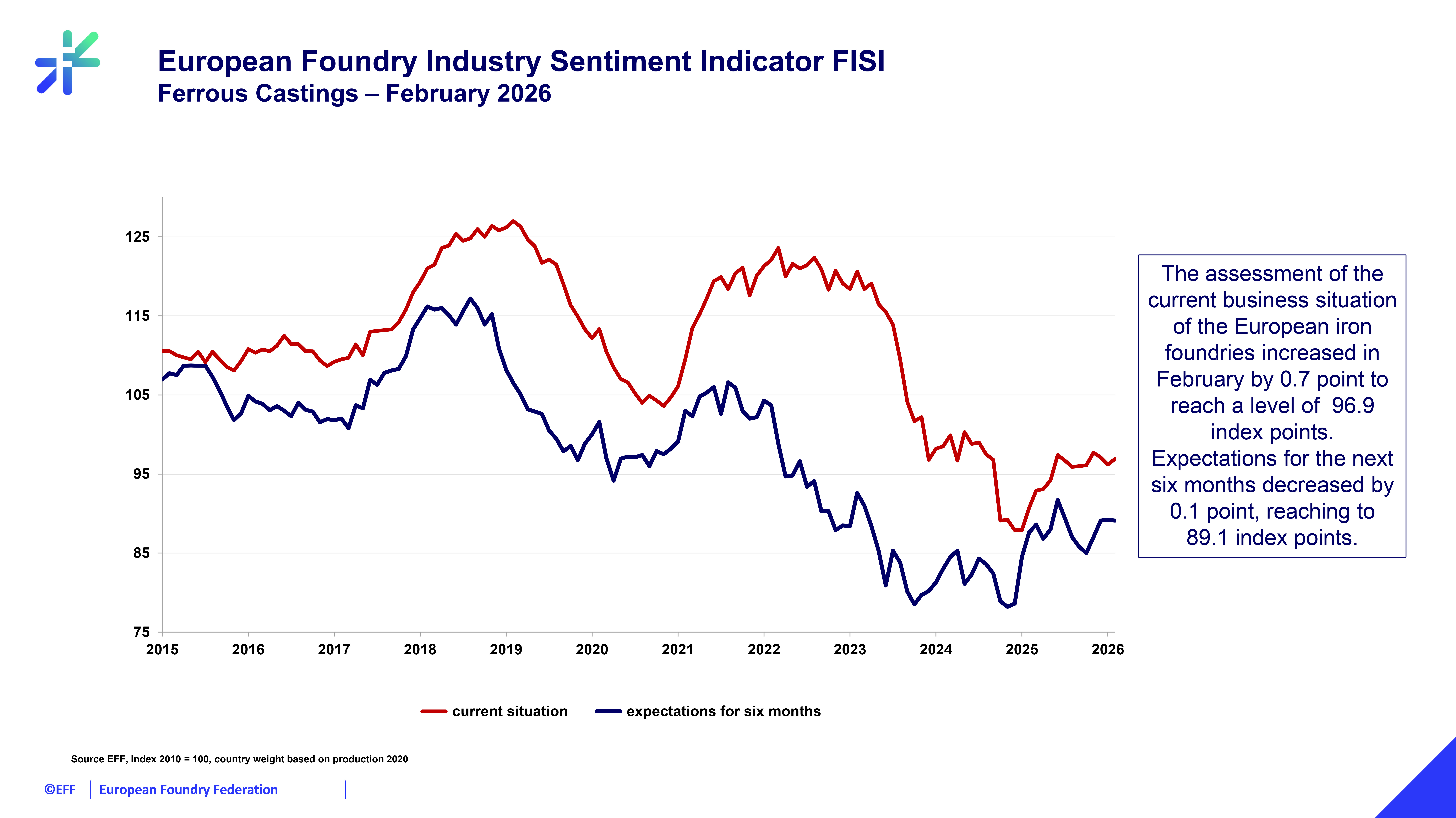
L'évaluation globale de la situation économique actuelle pour le secteur de la fonderie de fonte s'est légèrement améliorée en février, progressant de 0,7 point pour atteindre 96,9. Toutefois, les prévisions pour les six prochains mois ont légèrement reculé de 0,1 point, à 89,1, ce qui témoigne d'une incertitude persistante quant aux perspectives à court terme.

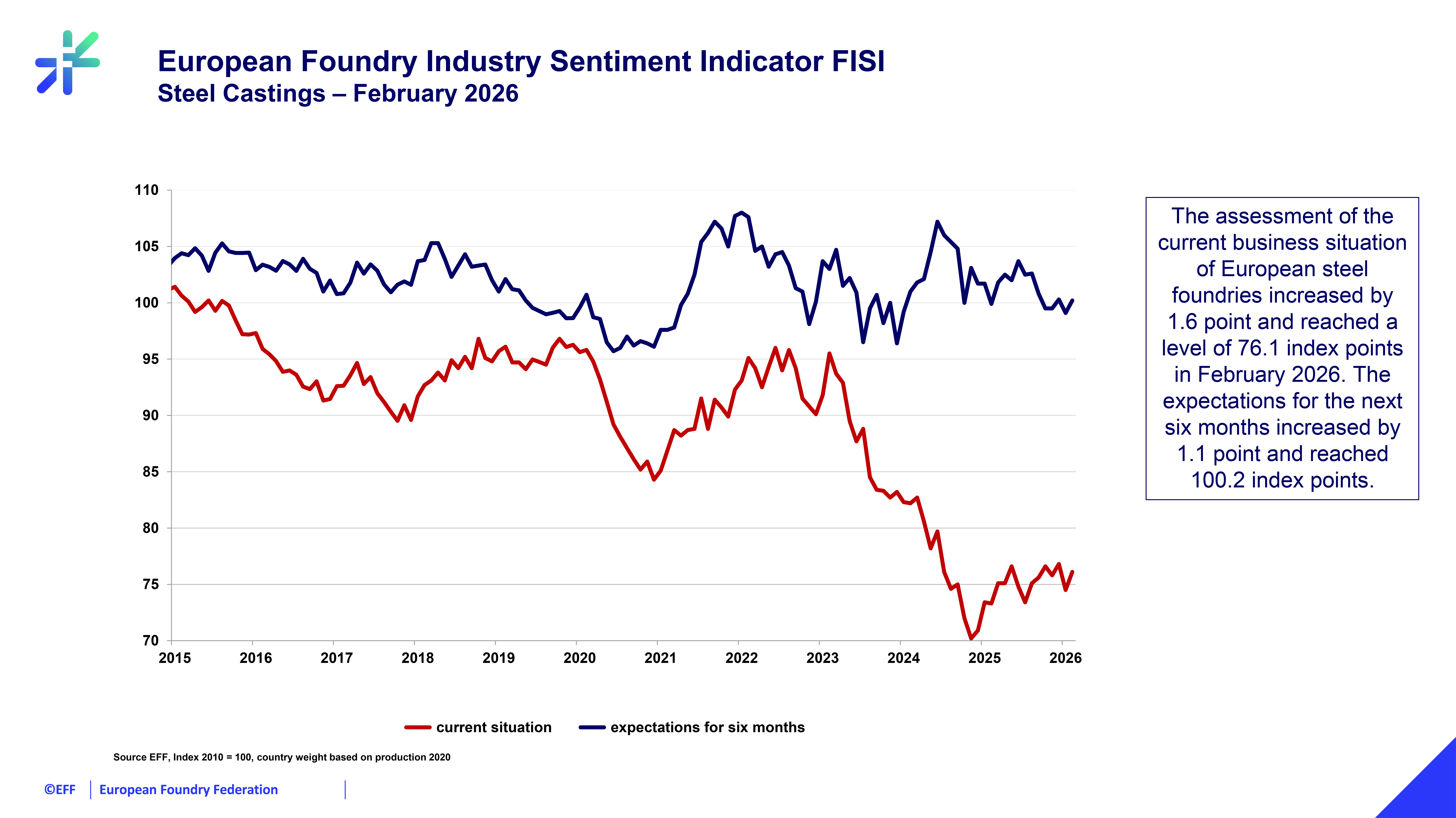
Dans le secteur de la fonderie d'acier, le climat d'affaires a affiché une dynamique plus positive. L'indice de la situation actuelle a nettement progressé de 1,6 point pour s'établir à 76,1, tandis que l'indice des prévisions a augmenté de 1,1 point pour atteindre 100,2, ce qui témoigne d'un optimisme prudent quant à la reprise dans ce secteur.

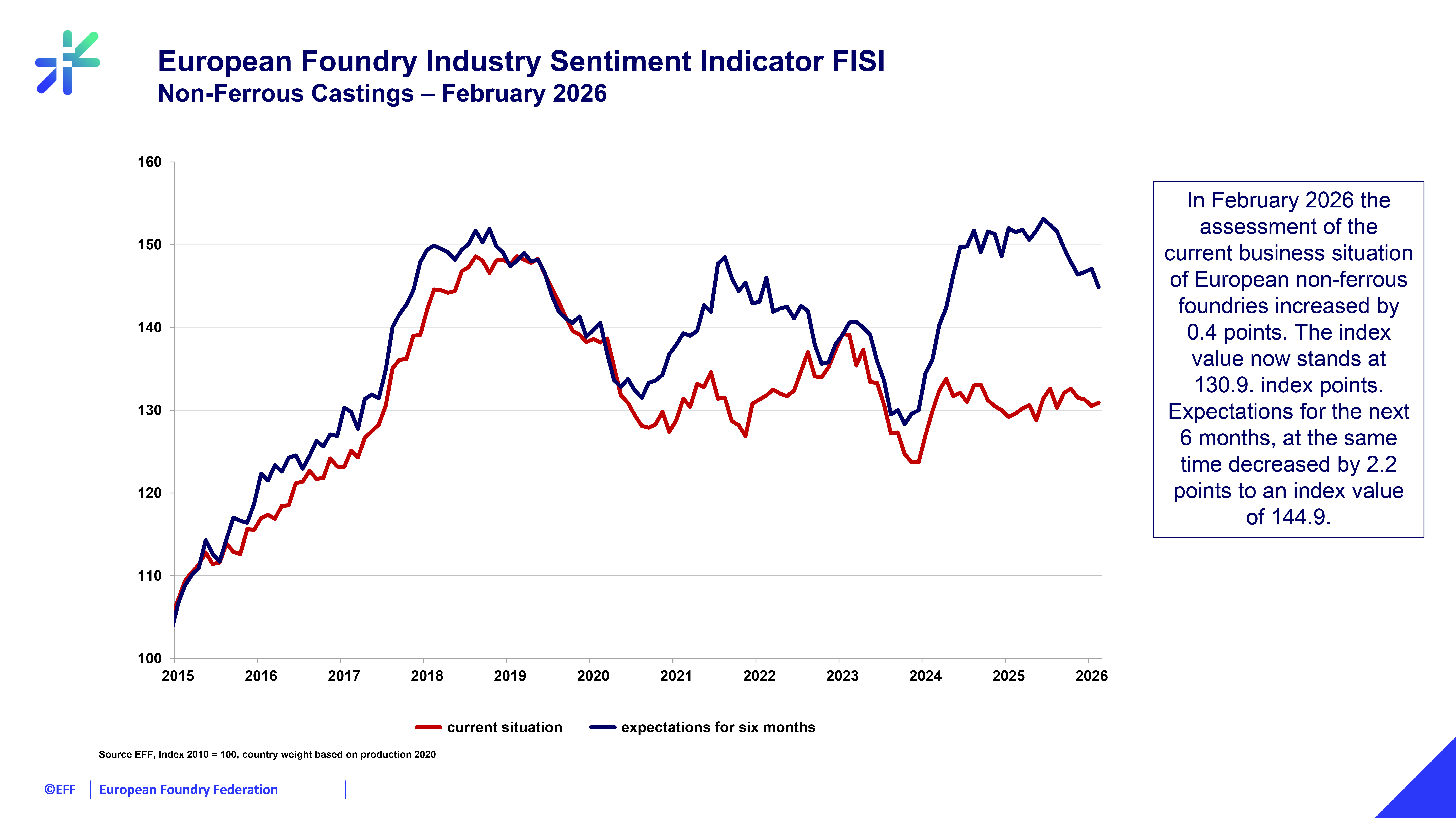
Le secteur de la fonderie de métaux non ferreux continue de surpasser les autres secteurs en termes de niveau d'activité actuel. L'indice de la situation actuelle a progressé de 0,4 point pour atteindre le niveau élevé de 130,9. Toutefois, les prévisions ont sensiblement reculé de 2,2 points à 144,9, ce qui laisse entendre que même ce secteur, relativement solide, s'attend à des difficultés dans les mois à venir.

Dans l'ensemble, l'indice FISI reste en deçà de son indice de référence à long terme, ce qui reflète les difficultés structurelles et conjoncturelles auxquelles le secteur continue de faire face. Si l'on constate une nette amélioration à court terme des conditions économiques actuelles, notamment dans les secteurs de la fonte d'acier et des métaux non ferreux, l'assombrissement des perspectives met en évidence des inquiétudes persistantes liées à la volatilité de la demande, aux coûts énergétiques et à l'incertitude économique générale en Europe.

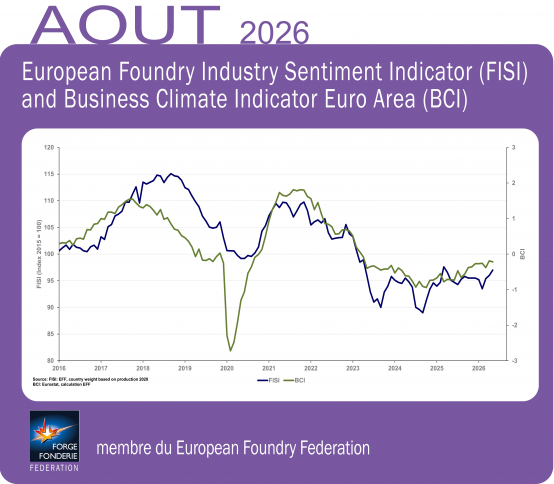
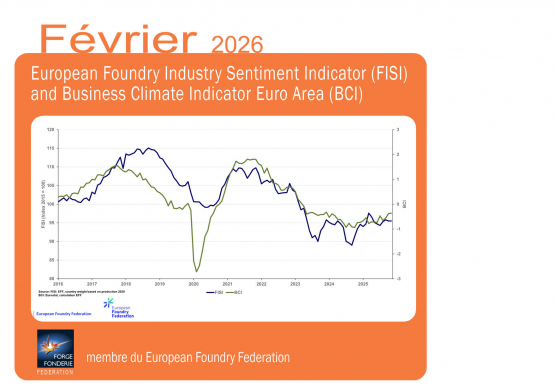
L’indice BCI (*) publié par la Commission européenne poursuit sa remontée pour s’établir à -0,36 point en février 2026 (contre - 0,38 en janvier et - 0,56 en décembre 2025).

L'indice des directeurs d'achat (PMI Purchasing Managers’ Index**) de l'industrie manufacturière de la zone euro repart à la hausse, repassant à 50,8 points en février 2026 contre 49,5 en janvier 2026.


Source : Traduction du communiqué EFF (https://eff-eu.org/european-foundry-industry-sentiment-76/).


(*) Indice BCI : Business Climate Indicator. Indice de l’évolution du secteur manufacturier en zone euro publié par la Commission européenne à partir d’enquêtes sectorielles (tendances de la production ; carnets de commandes ; carnets de commandes à l'exportation ; stocks ; attentes en matière de production). Valeur égale à 0 : Situation neutre, ni optimisme ni pessimisme marqué.

(**) L'indice des directeurs d'achat (PMI) dans la zone euro est un indicateur de la santé économique du secteur manufacturier. Il est basé sur des indicateurs tels que les nouvelles commandes, les niveaux de stocks, la production, les livraisons des fournisseurs et l'environnement de l'emploi.

News
March 26 2026

European Foundry Industry Sentiment Index (FISI) February 2026

The European Foundry Industry Sentiment Index (FISI) indicates a cautiously stabilizing outlook in February 2026
European Foundry Industry Sentiment Index (FISI), published monthly by European Foundry
Federation, in February 2026 kept the same level as in previous month – reaching a value of
95.5 points.


The latest data from the European Foundry Federation (EFF), indicate a cautiously stabilizing
yet still fragile outlook for the European foundry industry in February 2026. According to the
European Foundry Industry Sentiment Index (FISI), the sector presents a mixed picture, with
modest improvements in current conditions contrasted by weakening expectations in several
segments.
The overall assessment of the current business situation in European iron foundries improved
slightly in February, rising by 0.7 points to 96.9. However, expectations for the next six months
edged down by 0.1 points to 89.1, signaling continued uncertainty about near-term prospects.
In the steel casting segment, sentiment showed more positive momentum. The current
situation index increased significantly by 1.6 points to 76.1, while expectations rose by 1.1
points to 100.2, indicating cautious optimism for recovery in this segment.
Non-ferrous foundries continue to outperform other segments in terms of current activity levels.
The current situation index rose by 0.4 points to a strong 130.9. However, expectations
declined notably by 2.2 points to 144.9, suggesting that even this relatively robust segment
anticipates headwinds in the coming months.
Overall, the FISI remains below its long-term benchmark, reflecting a sector still navigating
structural and cyclical challenges. While short-term improvements in current business
conditions are evident, particularly in steel and non-ferrous castings, weakening expectations
highlight persistent concerns related to demand volatility, energy costs, and broader economic
uncertainty in Europe.
The divergence between improving present conditions and softening future expectations
underscores the delicate balance facing the European foundry industry. Companies continue
to operate in a complex environment shaped by geopolitical tensions, fluctuating industrial
demand, and the ongoing transition toward greener production technologies.
EFF emphasizes that maintaining competitiveness will require continued investment in
innovation, energy efficiency, and workforce skills. At the same time, supportive policy
frameworks at the European level remain essential to ensure the long-term resilience of this
strategically important industry.
The Business Climate Indicator (BCI), published by the European Commission, reached -0.36
in February 2026, compared to the previous reading of -0.38 in January 2026.
The Eurozone Manufacturing PMI in February 2026 reached a level of 50.8 which was an
increase by 0.7 point from the value of 49.5 in January 2026.
_____________________________________________________________
The FISI – European Foundry Industry Sentiment Indicator – is the earliest available composite indicator
providing information on the European foundry industry performance. It is published by EFF every month and is
based on survey responses of the European foundry industry. The EFF members are asked to give their
assessment of the current business situation in the foundry sector and their expectations for the next six months.
The BCI – Business Climate Indicator – is an indicator published by the European Commission. The BCI
evaluates development conditions of the manufacturing sector in the euro area every month and uses five balances
of opinion from industry survey: production trends, order books, export order books, stocks and production
expectations.
Purchasing Managers' Index (PMI) - in the Euro area is an indicator of the economic health of the manufacturing
sector. It is based on such indicators as: new orders, inventory levels, production, supplier deliveries and the
employment environment.

Background information on EFF:
EFF is the umbrella organisation of the national European foundry associations. The organisation, founded in 1953,
has 22 European member states and works to promote the economical, technical, legal and social interests of the
European foundry industry. At the same time, EFF implements activities which aim at developing national foundry
industries and co-ordinating their shared international interests. The General Secretariat is situated in Düsseldorf
since 1997.
EFF represents 4 400 European foundries. Nearly 260 000 employees are generating a turnover of 39 billion Euro.
European foundries are recruiting 20 000 workers and engineers per year. The main customer industries are e.g.
the automotive, the general engineering and the building industries as well as the electrical engineering industry.
No industrial sector exists without using casted components.
Further information at eff-eu.org/ and LinkedIn EFF.
___________________________________________________________________
EFF Contact:
Witold Dobosz
EFF – European Foundry Federation
mail: info@eff-eu.org

 eff-eu.org
 

Read more
 
All news >
Directory
Forge Fonderie
Magazine
Indicators
Press Room
Join us
Contact

Fédération Forge Fonderie
Head office
45 rue Louis Blanc F-92400 Courbevoie
Write us
45 rue Louis Blanc CS 30080 92038 La Défense Cedex

Tel. +33 (0)1 43 34 76 30
Fax. +33 (0)1 43 34 76 31


Access map

The Fédération Forge Fonderie is the French professional organization of metal shaping industries through forging, casting, metal additive manufacturing and related machining.

© 2016 Fédération Forge Fonderie - Credits & legal notice