Back To Top
Plateforme adhérents
ENG
Forging & casting
Accueil > Forging & casting > Materials
Materials
Partager | Send by e-mail |
Les différents métaux et alliages utilisés possèdent chacun des propriétés particulières qui confèrent aux pièces réalisées des capacités de résistance mécanique, des degrés de légèreté, de conductivité… différents. Ils sont donc choisis en fonction de la destination de chaque application selon un cahier des charges précis établi avec le client.

Les métaux ferreux :
des alliages de fer et de carbone, associés à d’autres éléments

Les aciers : alliages de fer et de carbone (< 0,6%)

Les aciers sont des alliages de fer et de carbone dont le taux est en général inférieur à 0,6% présentant d'excellentes caractéristiques mécaniques. L'augmentation du pourcentage de carbone améliore la dureté, la résistance à la rupture, la limite élastique, la résistance à la corrosion, la résistance à l'usure et la trempabilité, mais elle diminue la malléabilité, la résilience et la soudabilité.

Les aciers représentent environ 95% des métaux utilisés dans le secteur de la forge, contre 12% de ceux utilisés dans le secteur de la fonderie, et sont classés en 3 grandes familles principales

   Aciers carbone


Automobile, Poids lourd, TP, Agricole, outillage à main, coutellerie, arbres de transmission,…

   Aciers faiblement alliés


Automobile, Poids lourd, TP, Agricole, coutellerie, arbres de transmission,…

   Aciers fortement alliés :

   Aciers inox

   Aciers réfractaires

   Aciers outils

Chimie, nucléaire, alimentaire, aéro, energie, petrole


L’ajout d’éléments influence les caractéristiques mécaniques des pièces produites, par exemple :


- le Manganèse (Mn) : augmente la limite élastique, la trempabilité et la résistance à l’abrasion

- le Nickel (Ni) : augmente la résistance aux chocs et à la corrosion

- le Silicium (Si) : augmente la limite élastique

- le Tungstène (W) : augmente la résistance à l’usure et à la chaleur

- le Molybdène (Mo) : augmente la résistance à l’usure et à la chaleur

- le Vanadium (V) : augmente la résistance à l’usure et aux déformations


Des gammes de caractéristiques mécaniques étendues sont obtenues après traitement thermique.


Les fontes : des alliages de fer et de carbone (2,5 à 4%)

Les fontes sont des alliages où le taux de carbone est élevé (2,5 à 4%).

Il s’agit d’un matériau présentant de très bonnes propriétés d’utilisation mais peu d’élasticité à la traction. Cela tient à la présence du carbone sous forme de lamelles de graphite libre qui cristallise dans la matrice métallique, celles-ci créent des amorces de rupture entraînant une certaine fragilité : ces fontes sont dénommées fontes à graphite lamellaire.

Pour améliorer leurs propriétés, on a recours à des éléments d’addition (nickel, chrome ...). Il s’agit alors de fontes dites alliées dont la teneur en carbone est généralement inférieure à 3%.


Les fontes à graphite sphéroïdal possèdent des caractéristiques qui dépassent celles de certains aciers, notamment en ce qui concerne leur résistance à la fatigue : cela tient au fait que dans ces fontes le graphite cristallise sous forme de petites sphères et non de lamelles.


Fonte à graphite lamellaire (GL)

+ Bonne usinabilité, rigidité, résistance à la corrosion et à la compression, bonne absorption des vibrations, excellente coulabilité
- Fragile comparée aux aciers et à la fonte GS

Machines-outils, pièces mécaniques, chauffage, contrepoids, automobile

Fonte à graphite sphéroïdal (GS)

+ Caractéristiques mécaniques élevées, grande ductilité, bonne usinabilité en structure ferritique et assez bonne en perilitique, bonne coulabilité et soudabilité, bonne élasticité

Pièces mécaniques, pièces automobiles (pièces de liaison au sol, pièces de sécurité : composants moteurs type vilebrequins, freinage, freinage, supports de fusée de roue…), pièces ferroviaires, agricoles, hydrauliques, pour travaux publics, tuyaux d’adduction d’eau

Fonte à graphite vermiculaire (GV)

+ Avec un graphite dont la forme est comprise entre les lamelles et les sphères, la FGV allie les avantages de la FGL sans ses inconvénients (Fragilité)

-  La principale difficulté est la maîtrise reproductibilité de sa structure

Transports terrestres : carters-cylindres et culasses de gros moteurs (2,5 à 7 litres de cylindrée) en véhicules particuliers, et  camion


Métaux non-ferreux :
alliages ne comprenant pas de fer, ou dans des proportions très faibles

Cuivres et alliages cuivreux

Le cuivre est le premier métal travaillé par l'homme avec l'or. Il est facile à travailler, ses alliages sont utilisés en forge comme en fonderie, et ses usages très diversifiés. On peut citer en principales caractéristiques une excellente résistance à la corrosion et très bonne conductibilité électrique.

Bronze (Cuivre-Etain)

+ Conductivité électrique et thermique parmi les plus élevées

Excellente coulabilité

Faible dureté l’usinage et la découpe

Résistance à l’usure (propriétés anti-frottement)

Amagnétisme

Soudabilité et aptitude au brasage

Aptitude au polissage et aux traitements de décoration

Bon coefficient de dilatation

Bonne résistance mécanique et dureté

Résistance à la corrosion particulièrement en milieu marin

Caractéristiques mécaniques élevées

Cloches, équipements électriques et électroniques, connectique, échangeurs de chaleur, robinetterie industrielle et sanitaire, plomberie, construction navale aérospatiale et aéronautique, pièces d’étanchéité en milieu marin, échangeurs marins, énergie nucléaire, automobile, ferroviaire, bâtiment, plomberie

Laiton (Cuivre-Zinc)

Cupro-aluminiums (Cuivre-Aluminium)


Alliages légers et ultralégers


Les alliages légers sont élaborés à partir d’aluminium et les alliages ultra légers à partir de magnésium. Les principales propriétés de l'aluminium sont sa légèreté, sa bonne résistance à l'oxydation et sont excellente conductivité électrique et thermique.


Alliages d’aluminium et de silicium

+ Légèreté, bonne coulabilité, usinabilité et propriétés d'aspect

Automobile, aéronautique et spatial, mécanique, chimie

Alliages d’aluminium et de cuivre

+ Bonnes caractéristiques mécaniques, bonne usinabilité
- Mauvaise tenue à la corrosion, criquabilité importante

Tuyauteries, raccords

Alliages d’aluminium et de magnésium

+ Bonne usinabilité et grande résistance à la corrosion
- Coulabilité moins bonne et criquabilité importante

Piston, aubes de compresseurs


Alliages de zinc et zamak

Les alliages de zinc sont le plus souvent alliés à l’aluminium (de 4 à 30%) et contiennent parfois de faibles additions de magnésium (de 0,012 à 0,06%) et de cuivre (jusqu’à 3%).

 Le plus couramment utilisé (95% du marché) est appelé zamak (zinc pur à 99,995%).

 Sa coulabilité et sa bonne pénétration en font un alliage adapté à la coulée sous-pression qui permet d’obtenir des pièces minces et/ou de configuration compliquée.


Zamak (Aluminium, Magnésium, cuivre)

+ Très bonne coulabilité, stabilité dimensionnelle, résistance à la corrosion

Automobile, bâtiment, décoration, électricité, électronique, parfumerie


Les super-alliages

Ces alliages haute performance présentent d'excellentes résistances mécaniques, notamment en fatigue thermique, corrosion à chaud ou torsion


Hastelloy

Inconel

Monel

+ Bonne résistance mécanique (pression, torsion, fatigue), résistance à la corrosion, grande résistance à hautes températures

Aéronautique (turbines, turboréacteurs), sport automobile, marine

Partager | Send by e-mail |
News
September 3 2026

European Foundry Industry Sentiment in July 2026

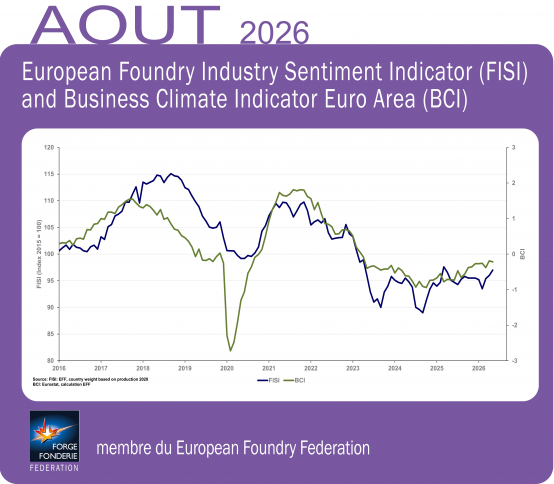
European Foundry Industry Sentiment improves in July 2026, but recovery remains uneven. FISI rises to 96.0 as Eurozone manufacturing continues to expand.
The European foundry industry recorded a further improvement in business sentiment in July 2026. The European Foundry Industry Sentiment Indicator (FISI), published monthly by EFF – European Foundry Federation. increased to 96.0 points, confirming the gradual stabilisation observed in recent months. Nevertheless, the indicator remains below the benchmark level of 100, showing that the recovery of the European foundry sector is still fragile and highly uneven across individual casting segments.


The development of FISI should also be viewed against the background of a slowly improving European manufacturing environment. The Eurozone Manufacturing PMI reached 52.0 points in July, remaining above the critical threshold of 50 and therefore signalling an expansion of manufacturing activity.
At the same time, the Business Climate Indicator (BCI) stood at -0.19, remaining in negative territory despite the improvement in manufacturing activity. The combination of a PMI above 50 and a still-negative BCI illustrates the mixed economic environment facing European industry: production activity is recovering, but companies remain cautious about demand, investment and future business conditions.
Iron foundries improve, but expectations weaken
The situation in European iron foundries improved noticeably in July. The assessment of the current business situation increased by 1.4 points to 100.0 index points. This is an encouraging signal, bringing the assessment of current conditions back to the benchmark level. However, expectations for the next six months moved in the opposite direction, decreasing by 1.1 points to 85.3.
The divergence between improving current conditions and weakening expectations indicates that iron foundries remain cautious about the sustainability of the recovery. Demand from major customer industries remains uneven, and companies continue to operate in an environment characterized by uncertainty regarding future orders, industrial investment and production volumes.
Steel foundries remain the weakest segment
The steel casting sector continues to face the most difficult market conditions among the major European foundry segments. In July, the assessment of the current business situation of European steel foundries increased only marginally, by 0.1 point to 74.3 index points. At the same time, expectations for the next six months decreased by 1.3 points to 97.6 points.
The very low assessment of the current situation confirms that steel foundries continue to struggle with weak demand and insufficient capacity utilization. Although expectations remain significantly above the assessment of present conditions, their decline in July suggests that companies are becoming somewhat more cautious about the pace of a future recovery.

Non-ferrous foundries remain the strongest part of the industry
The situation is considerably more positive in the European non-ferrous foundry sector. In July 2026, the assessment of the current business situation increased by 1.3 points to 133.2 index points. At the same time, expectations for the next six months improved strongly, rising by 2.9 points to 149.0.
Non-ferrous foundries therefore remain by far the strongest segment of the European foundry industry. Both current conditions and expectations are substantially above the benchmark level.
The segment continues to benefit from structural demand connected with lightweight components, electrification, energy technologies and advanced industrial applications. The July results show that non-ferrous foundries continue to demonstrate considerably greater resilience than the ferrous casting sectors.


European manufacturing recovery offers cautious optimism
The Eurozone Manufacturing PMI of 52.0 in July provides an important positive signal for foundries. A PMI above 50 indicates expanding manufacturing activity and suggests that the broader industrial environment is gradually becoming more supportive.
This follows the stabilization already observed in the European foundry sector in June, when EFF reported the first meaningful improvement in business sentiment after several challenging months. However, the July figures show that the recovery has not yet translated into equally strong confidence across all foundry segments.
European foundries remain exposed to weak and uneven demand from key customer industries, high energy and production costs, geopolitical uncertainty and increasing global competition. EFF has also highlighted the importance of creating a level playing field for European foundries in the context of the Carbon Border Adjustment Mechanism (CBAM). The Federation has warned that the current framework risks increasing the cost of imported raw materials while leaving many imported finished foundry products outside the mechanism’s scope. This imbalance represents a significant competitiveness challenge for an energy-intensive European industry already facing strong competition from third-country producers.

Outlook: stabilization, but no broad-based recovery yet
The July 2026 FISI results provide grounds for cautious optimism. The rise of the overall indicator to 96.0, combined with a Manufacturing PMI of 52.0, suggests that the European industrial economy is moving in a more positive direction.
However, the BCI of -0.19 and the significant differences between individual foundry segments demonstrate that a broad-based recovery has not yet been achieved.
The contrast is particularly striking: non-ferrous foundries report very strong current conditions and expectations, while steel foundries continue to operate at historically weak levels. Iron foundries are experiencing an improvement in their current situation, but their expectations for the coming six months remain subdued.
For the European foundry industry, the coming months will therefore be decisive. A sustainable recovery will depend on stronger order intake from key customer sectors, continued improvement in European manufacturing, competitive energy prices and an EU industrial and trade policy capable of protecting the competitiveness of European production.
European foundries are strategically important suppliers to the automotive, machinery, energy, railway, aerospace, defense, construction and infrastructure sectors. Maintaining a competitive European foundry industry is therefore essential not only for individual companies, but also for resilient European industrial supply chains and Europe’s long-term industrial sovereignty.

The FISI – European Foundry Industry Sentiment Indicator – is the earliest available composite indicator providing information on the European foundry industry performance. It is published by EFF every month and is based on survey responses of the European foundry industry. The EFF members are asked to give their assessment of the current business situation in the foundry sector and their expectations for the next six months.
The BCI – Business Climate Indicator – is an indicator published by the European Commission. The BCI evaluates development conditions of the manufacturing sector in the euro area every month and uses five balances of opinion from industry survey: production trends, order books, export order books, stocks and production expectations.
Purchasing Managers' Index (PMI) - in the Euro area is an indicator of the economic health of the manufacturing sector. It is based on such indicators as: new orders, inventory levels, production, supplier deliveries and the employment environment.
Please find the chart enclosed or combined with additional information at eff-eu.org/.
Background information on EFF:
EFF is the umbrella organisation of the national European foundry associations. The organisation, founded in 1953, has 22 European member states and works to promote the economical, technical, legal and social interests of the European foundry industry. At the same time, EFF implements activities which aim at developing national foundry industries and co-ordinating their shared international interests. The General Secretariat is situated in Düsseldorf since 1997.
EFF represents 4 400 European foundries. Nearly 260 000 employees are generating a turnover of 39 billion Euro. European foundries are recruiting 20 000 workers and engineers per year. The main customer industries are e.g. the automotive, the general engineering and the building industries as well as the electrical engineering industry. No industrial sector exists without using casted components.
Further information at eff-eu.org
___________________________________________________________________
EFF Contact:
Witold Dobosz
EFF – European Foundry Federation
mail: info@eff-eu.org
________________________________________

Read more
 
All news >
Directory
Forge Fonderie
Magazine
Indicators
Press Room
Join us
Contact

Fédération Forge Fonderie
Head office
45 rue Louis Blanc F-92400 Courbevoie
Write us
45 rue Louis Blanc CS 30080 92038 La Défense Cedex

Tel. +33 (0)1 43 34 76 30
Fax. +33 (0)1 43 34 76 31


Access map

The Fédération Forge Fonderie is the French professional organization of metal shaping industries through forging, casting, metal additive manufacturing and related machining.

© 2016 Fédération Forge Fonderie - Credits & legal notice