Back To Top
Plateforme adhérents
ENG
News
Accueil > News > Climat des affaires dans l’industrie européenne de la fonderie en mai 2026
Climat des affaires dans l’industrie européenne de la fonderie en mai 2026
1 July 2026
Partager | Imprimer

L’indice FISI (Foundry Industry Sentiment Indicator) est publié chaque mois par l’association européenne de fonderie EFF à partir des réponses des organisations membres, dont pour la France, la Fédération Forge Fonderie, sur le climat des affaires dans le secteur de la fonderie (fonte, acier et non-ferreux) à date et leurs attentes pour les six prochains mois.
Télécharger les résultats de l’indice FISI de mai 2026

L’industrie européenne de la fonderie reste sous pression en mai 2026

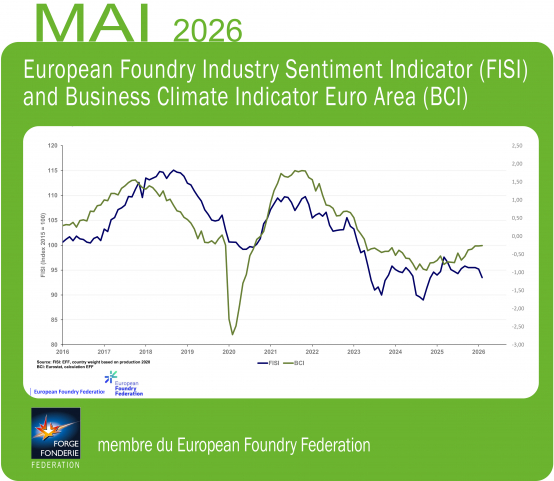
En mai 2026, l’indice FISI fait état d’un nouvel affaiblissement de la confiance des entreprises, passant de 95,2 points en avril à 93,5 points en mai. Alors que les fonderies de fonte et d’acier font état d’une détérioration de leurs conditions d’activité et d’une révision à la baisse de leurs prévisions pour les mois à venir, les fonderies de métaux non-ferreux continuent à faire preuve de résilience et de confiance dans l’évolution future du marché. Les conclusions générales reflètent un contexte industriel difficile en Europe, caractérisé par une demande modérée, des incertitudes économiques et une pression persistante sur l'activité manufacturière.

Les fonderies de fonte confrontées à une baisse de confiance

En mai 2026, les fonderies de fonte européennes font état d’une baisse tant de leur évaluation de la situation économique actuelle que de leurs prévisions pour les six prochains mois. L’indice de la situation actuelle a reculé de 2,4 points pour s’établir à 96,3, tandis que l’indice des prévisions a baissé de 2,7 points pour s’établir à 82,6. Ces chiffres indiquent que de nombreuses fonderies de fonte continuent de faire face à un faible volume de commandes et à des perspectives de marché incertaines, en particulier dans les secteurs liés à la production industrielle traditionnelle et à l’activité de construction.

La fonderie d’acier reste le segment le plus fragile

Les fonderies d’acier européennes ont enregistré les niveaux de confiance les plus bas parmi tous les secteurs de la fonderie. L’indice de la situation économique actuelle a reculé de 2,0 points pour s’établir à 72,7, reflétant des conditions d’exploitation qui restent difficiles. Les prévisions pour les six prochains mois se sont également affaiblies, reculant de 1,5 point pour s’établir à 96,6. Bien que les prévisions restent proches du seuil de référence neutre, le secteur continue de rencontrer des difficultés liées à une demande insuffisante et à un faible taux d’utilisation des capacités.

Le secteur des métaux non-ferreux continue d’afficher de meilleurs résultats

En revanche, les fonderies de métaux non ferreux ont conservé une position solide. Bien que l’évaluation de la situation économique actuelle ait légèrement reculé de 0,5 point, l’indice s’est maintenu à un niveau élevé de 132,8. Les prévisions pour les six prochains mois se sont encore améliorées, progressant de 1,5 point pour atteindre 147,4. Ces perspectives positives reflètent une demande soutenue dans des secteurs tels que l’électrification, les énergies renouvelables, les solutions de mobilité légère et les applications d’ingénierie de pointe, qui reposent tous largement sur l’aluminium et d’autres pièces moulées non ferreuses.


Les indicateurs économiques généraux en Europe restent mitigés

L’évolution de l’industrie de la fonderie correspond aux indicateurs économiques généraux observés à l’échelle européenne. L’indice BCI (*) publié par la Commission européenne est resté en mai 2026 en dessous de sa moyenne à long terme, ce qui indique que la confiance des entreprises industrielles ne s’est pas encore pleinement rétablie. Les industriels continuent de faire face à des incertitudes géopolitiques, à des coûts de production élevés et à une attitude prudente en matière d’investissement dans l’ensemble de l’économie européenne.

L'indice des directeurs d'achat (PMI Purchasing Managers’ Index**) de l'industrie manufacturière de la zone euro s’établit à 51,6 en mai, se maintenant au-dessus du seuil critique de 50 et indiquant une croissance modérée de l’activité manufacturière. Toutefois, le PMI a reculé par rapport aux niveaux d’avril, ce qui suggère un ralentissement du rythme de la reprise.

Alors que la production manufacturière a continué de progresser, les entreprises ont fait état d’une croissance plus faible des commandes et de réductions d’effectifs persistantes. L’indice PMI composite de la zone euro, plus large, est resté inférieur à 50, soulignant la faiblesse économique persistante en dehors du secteur manufacturier.


Source : Traduction du communiqué EFF (https://eff-eu.org/european-foundry-industry-sentiment-79/).

(*) Indice BCI : Business Climate Indicator. Indice de l’évolution du secteur manufacturier en zone euro publié par la Commission européenne à partir d’enquêtes sectorielles (tendances de la production ; carnets de commandes ; carnets de commandes à l'exportation ; stocks ; attentes en matière de production). Valeur égale à 0 : Situation neutre, ni optimisme ni pessimisme marqué.

(**) L'indice des directeurs d'achat (PMI) dans la zone euro est un indicateur de la santé économique du secteur manufacturier. Il est basé sur des indicateurs tels que les nouvelles commandes, les niveaux de stocks, la production, les livraisons des fournisseurs et l'environnement de l'emploi.

News
September 29 2026

European Foundry Industry Sentiment improves in August 2026

European Foundry Industry Sentiment improves in August 2026 – expectations strengthen, but major differences between foundry segments remain.
The European foundry industry recorded a further improvement in business sentiment in August 2026. The European Foundry Industry Sentiment Indicator (FISI) increased to 97.0 points, up from 96.0 in July, continuing the gradual recovery seen after the weakness earlier this year. Nevertheless, FISI remains below the benchmark level of 100, underlining that the recovery of the European foundry industry is still incomplete and highly uneven across individual casting segments. The August data show a particularly strong contrast between steel foundries, which continue to face difficult current conditions, and the much stronger non-ferrous sector.

The FISI is the earliest available composite indicator providing information on the performance of the European foundry industry. It is published monthly by EFF - European Foundry Federation and is based on survey responses from the European foundry industry. EFF members assess both the current business situation and their expectations for the next six months.
European manufacturing environment continues to improve
The August FISI results should be viewed against a more encouraging manufacturing environment. European manufacturing also strengthened during August. The final Eurozone Manufacturing PMI reached 52.7, up from 51.9 in July and its highest level since May 2022. The improvement was supported by stronger manufacturing activity in Germany, although conditions remained uneven across individual European economies.
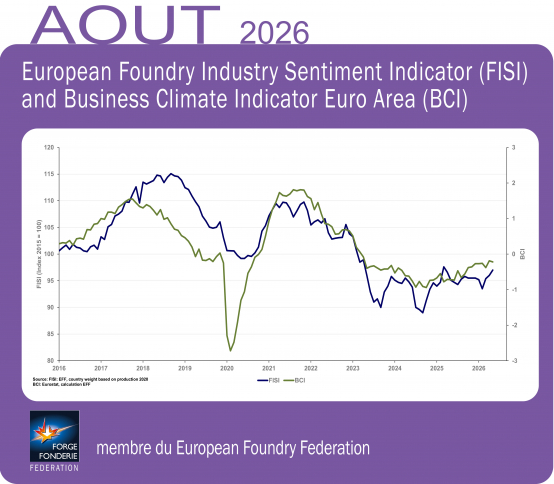
The Business Climate Indicator (BCI) for the euro area stood at -0.22 in August, compared with -0.19 in July. Although it therefore remains in negative territory, the longer-term chart shows that the business climate has recovered considerably from the lows recorded in 2024. The BCI is published by the European Commission and assesses conditions in euro-area manufacturing based on production trends, order books, export order books, stocks and production expectations.
Taken together, FISI at 97.0, BCI at -0.22 and European Manufacturing PMI at 52.7 present a mixed but gradually improving picture. Manufacturing activity is expanding, while confidence in the European foundry industry is recovering more slowly and remains below its benchmark level.


Iron foundries: current conditions soften, but expectations rebound
The situation of European iron foundries remained mixed in August. The assessment of the current business situation decreased by 0.5 points to 99.5 index points, bringing it just below the benchmark level of 100.
At the same time, however, expectations improved significantly. The index measuring expectations for the next six months increased by 2.7 points to 88.0.
This represents a notable change compared with July, when the current-situation indicator had improved to 100.0 while six-month expectations declined to 85.3. The August results therefore suggest that, although current market conditions have softened slightly, iron foundries have become more confident about the months ahead.
Nevertheless, expectations remain well below 100. This indicates continued caution regarding future order intake and demand from important customer industries. Iron foundries remain particularly exposed to developments in automotive production, mechanical engineering, commercial vehicles, agricultural machinery and other industrial sectors.
The August increase in expectations is encouraging, but a sustainable recovery will ultimately depend on stronger orders and higher production volumes across European manufacturing.


Steel foundries: current situation remains very weak, but expectations improve
European steel foundries continue to report the most difficult current conditions among the three major foundry segments. In August, the assessment of the current business situation increased slightly by 0.2 points to 74.5 index points. At the same time, expectations for the next six months increased by 0.6 points to 98.2.
The substantial gap between the current-situation index of 74.5 and expectations of 98.2 is particularly significant. It shows that steel foundries remain under considerable pressure today, but companies expect conditions to improve over the coming six months.
The July figures already showed this contrast, with current conditions at only 74.3 and expectations at 97.6. The August improvement in both indicators is therefore positive, although the extremely low current-situation reading confirms that a meaningful recovery in actual business activity has yet to materialize.
Steel foundries remain dependent on investment-intensive sectors such as heavy machinery, energy, mining, rail, infrastructure and defence. Stronger capital investment and industrial orders will therefore be essential if improved expectations are to translate into higher capacity utilisation and production.


Non-ferrous foundries remain the strongest segment
The picture is substantially more positive for European non-ferrous foundries. In August 2026, the assessment of the current business situation increased by 0.4 points to 133.6 index points. Expectations for the next six months strengthened even more, rising by 1.9 points to 150.9.
Both indicators are not only well above the benchmark level but also considerably stronger than those recorded in the iron and steel casting segments. In July, the current-situation indicator stood at 133.2 and expectations at 149.0, meaning that the sector strengthened further in August.
Non-ferrous foundries therefore remain the strongest part of the European foundry industry. The segment continues to benefit from demand connected with lightweight components, electrification, energy technologies and advanced industrial applications.
The particularly high six-month expectations reading of 150.9 indicates strong confidence compared with the ferrous casting sectors and suggests that non-ferrous foundries expect favourable market conditions to continue.
Outlook: recovery is becoming more visible, but remains uneven
The August results provide grounds for cautious optimism. Overall FISI increased from 96.0 to 97.0, while global manufacturing activity remained firmly in expansion territory with a PMI of 52.3. Eurozone manufacturing strengthened further, reaching a PMI of 52.7. At the same time, the BCI remained negative at -0.22, demonstrating that the broader European industrial environment is not yet free of uncertainty.
The differences between individual foundry segments remain striking. Iron foundries are close to the benchmark level in their assessment of current conditions, but their expectations remain subdued. Steel foundries continue to experience particularly weak current business conditions, despite substantially stronger expectations for the coming six months. Non-ferrous foundries, by contrast, report both strong current conditions and very positive expectations.


For European foundries, the key question is now whether improving manufacturing activity and stronger expectations will translate into higher order intake, increased capacity utilisation and stronger investment by customer industries.
The industry continues to face significant structural challenges, including high energy and production costs, geopolitical uncertainty, global competition and uneven demand from key customer sectors. EFF has also highlighted competitiveness issues related to the EU's Carbon Border Adjustment Mechanism (CBAM), particularly the risk that European foundries face higher costs for imported raw materials while many imported finished foundry products remain outside the mechanism's scope.
European foundries are strategic suppliers to the automotive, machinery, energy, railway, aerospace, defence, construction and infrastructure sectors. Maintaining a competitive European foundry industry is therefore essential not only for foundry companies themselves, but also for resilient European industrial supply chains and Europe's long-term industrial competitiveness.
EFF – European Foundry Federation will continue to monitor developments through its monthly European Foundry Industry Sentiment Indicator (FISI), providing market intelligence on current conditions and expectations across the European foundry industry.
 

The FISI – European Foundry Industry Sentiment Indicator – is the earliest available composite indicator providing information on the European foundry industry performance. It is published by EFF every month and is based on survey responses of the European foundry industry. The EFF members are asked to give their assessment of the current business situation in the foundry sector and their expectations for the next six months.
The BCI – Business Climate Indicator – is an indicator published by the European Commission. The BCI evaluates development conditions of the manufacturing sector in the euro area every month and uses five balances of opinion from industry survey: production trends, order books, export order books, stocks and production expectations.
Purchasing Managers' Index (PMI) - in the Euro area is an indicator of the economic health of the manufacturing sector. It is based on such indicators as: new orders, inventory levels, production, supplier deliveries and the employment environment.
Please find the chart enclosed or combined with additional information at eff-eu.org/.
Background information on EFF:
EFF is the umbrella organisation of the national European foundry associations. The organisation, founded in 1953, has 22 European member states and works to promote the economical, technical, legal and social interests of the European foundry industry. At the same time, EFF implements activities which aim at developing national foundry industries and co-ordinating their shared international interests.
EFF represents 4 400 European foundries. Nearly 260 000 employees are generating a turnover of 39 billion Euro. European foundries are recruiting 20 000 workers and engineers per year. The main customer industries are e.g. the automotive, the general engineering and the building industries as well as the electrical engineering industry. No industrial sector exists without using casted components.
Further information at eff-eu.org/ and LinkedIn EFF.
___________________________________________________________________
EFF • European Foundry Federation
Alameda Urquijo 33, 1D, Abando 48008, Bilbao • Spain
info@eff-eu.org
Contact: info@eff-eu.org • eff-eu.org/ • LinkedIn EFF
7/7
EFF Contact:
Witold Dobosz
EFF – European Foundry Federation
mail: info@eff-eu.org
________________________________________

Read more
 
All news >
Directory
Forge Fonderie
Magazine
Indicators
Press Room
Join us
Contact

Fédération Forge Fonderie
Head office
45 rue Louis Blanc F-92400 Courbevoie
Write us
45 rue Louis Blanc CS 30080 92038 La Défense Cedex

Tel. +33 (0)1 43 34 76 30
Fax. +33 (0)1 43 34 76 31


Access map

The Fédération Forge Fonderie is the French professional organization of metal shaping industries through forging, casting, metal additive manufacturing and related machining.

© 2016 Fédération Forge Fonderie - Credits & legal notice