Back To Top
Plateforme adhérents
ENG
News
Accueil > News > Climat des affaires dans l’industrie européenne de la fonderie en avril 2026
Climat des affaires dans l’industrie européenne de la fonderie en avril 2026
1 June 2026
Partager | Imprimer

L’indice FISI (Foundry Industry Sentiment Indicator) est publié chaque mois par l’association européenne de fonderie EFF à partir des réponses des organisations membres, dont pour la France, la Fédération Forge Fonderie, sur le climat des affaires dans le secteur de la fonderie (fonte, acier et non-ferreux) à date et leurs attentes pour les six prochains mois.

Télécharger les résultats de l’indice FISI d’avril 2026 ICI
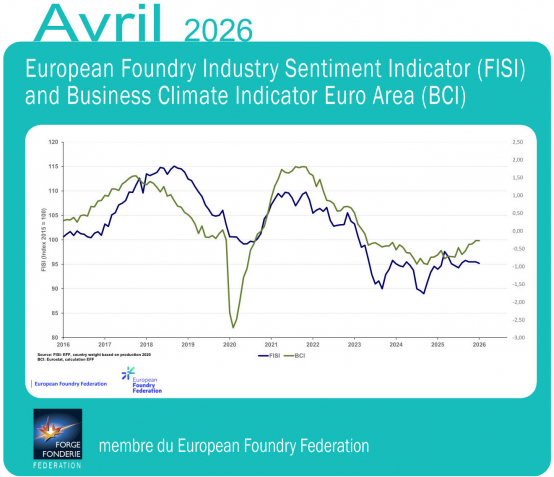
L'indice FISI continue d'évoluer dans un environnement économique difficile, marqué par une demande inégale, une dynamique industrielle faible et une incertitude croissante quant aux conditions futures du marché. Selon les dernières données, le secteur montre des signes de stabilisation dans certains segments, tandis que la confiance pour les six prochains mois reste fragile. La légère baisse de l’indice général à 95,2 points par rapport à mars 2026 (95,5 points) confirme que le secteur européen de la fonderie peine toujours à retrouver une dynamique de croissance durable, malgré des améliorations ponctuelles dans plusieurs segments de la fonderie.

A l’échelle européenne, les fonderies continuent de subir des pressions importantes dues aux coûts élevés de l'énergie, à l'instabilité géopolitique, à la faiblesse de la production industrielle sur les principaux marchés européens et à l'incertitude persistante qui règne au sein des chaînes d'approvisionnement des secteurs de l'automobile et de l'industrie manufacturière.


Fonderie de fonte : situation actuelle stable, mais perspectives en baisse

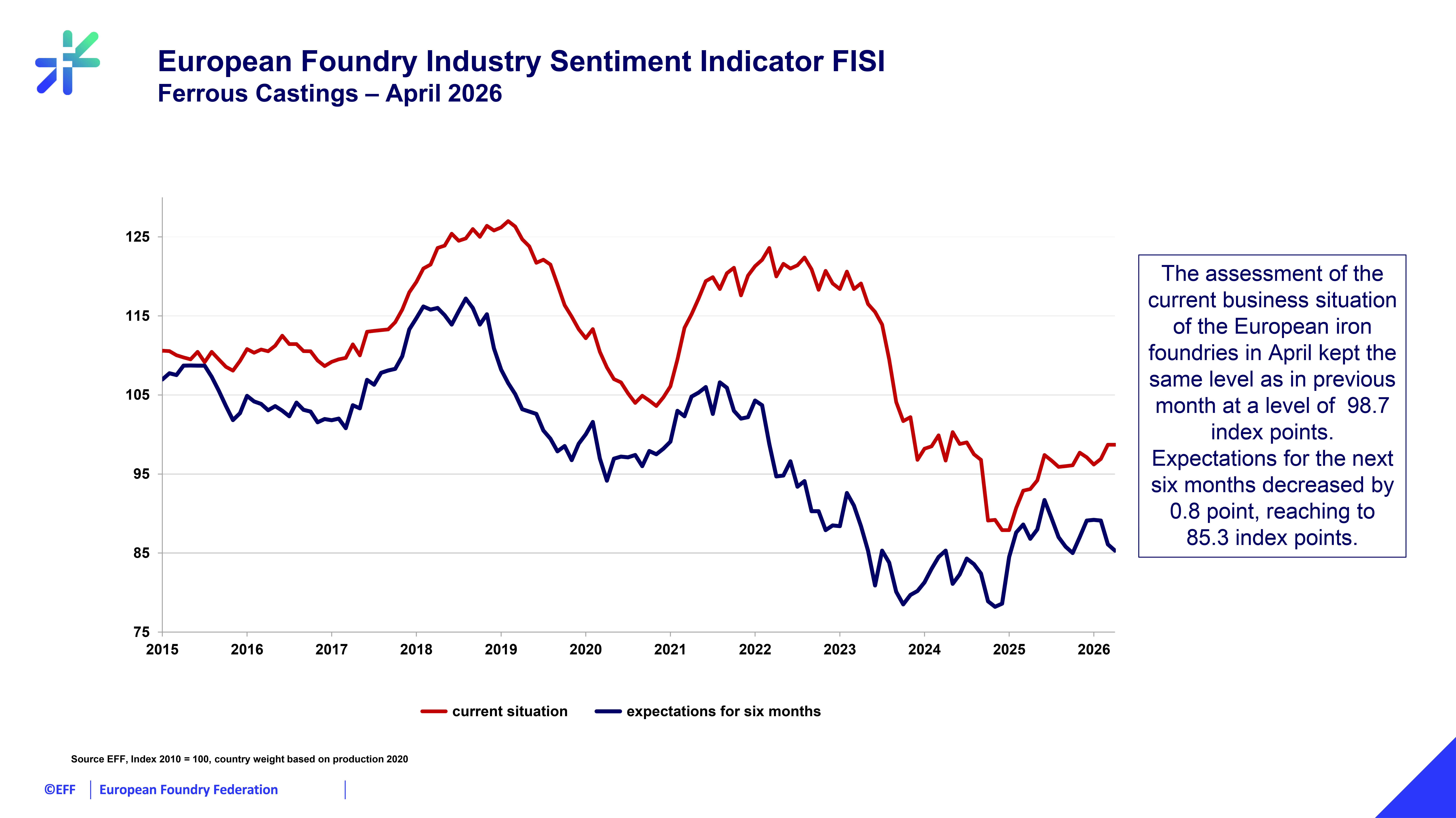
Dans le segment des pièces moulées en fonte, l'évaluation de la situation économique actuelle est restée inchangée en avril 2026, à 98,7 points d'indice. Cependant, les prévisions pour les six prochains mois ont encore baissé, à 85,3 points, soulignant la prudence croissante des fonderies de fonte à travers l'Europe. Les données suggèrent que, bien que l'activité opérationnelle se soit stabilisée à court terme, les entreprises restent préoccupées par les commandes futures, les investissements et la demande industrielle globale dans le secteur manufacturier européen.


Légère amélioration dans le secteur des fonderies d'acier

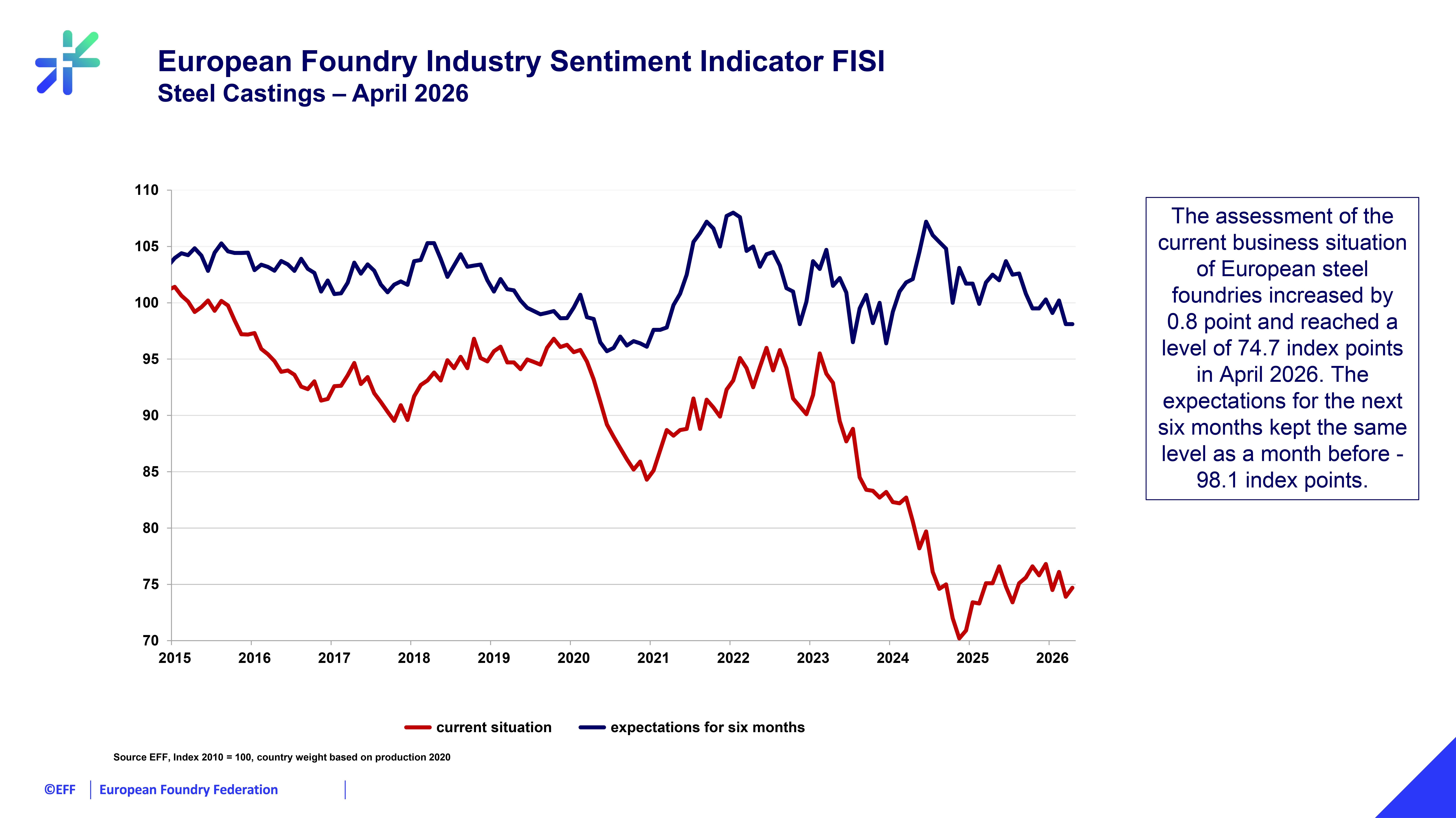
Le secteur des pièces moulées en acier a enregistré une légère amélioration de ses conditions d'activité actuelles. L'indice de la situation actuelle a augmenté de 0,8 point pour atteindre 74,7 points en avril 2026. Les prévisions pour les six prochains mois sont restées stables à 98,1 points. Malgré cette légère amélioration, le segment des pièces moulées en acier continue d'afficher des résultats bien inférieurs aux moyennes historiques, reflétant une demande modérée de la part des secteurs de l'industrie lourde, de la machinerie et des infrastructures.


Les fonderies de métaux non-ferreux restent le segment le plus dynamique

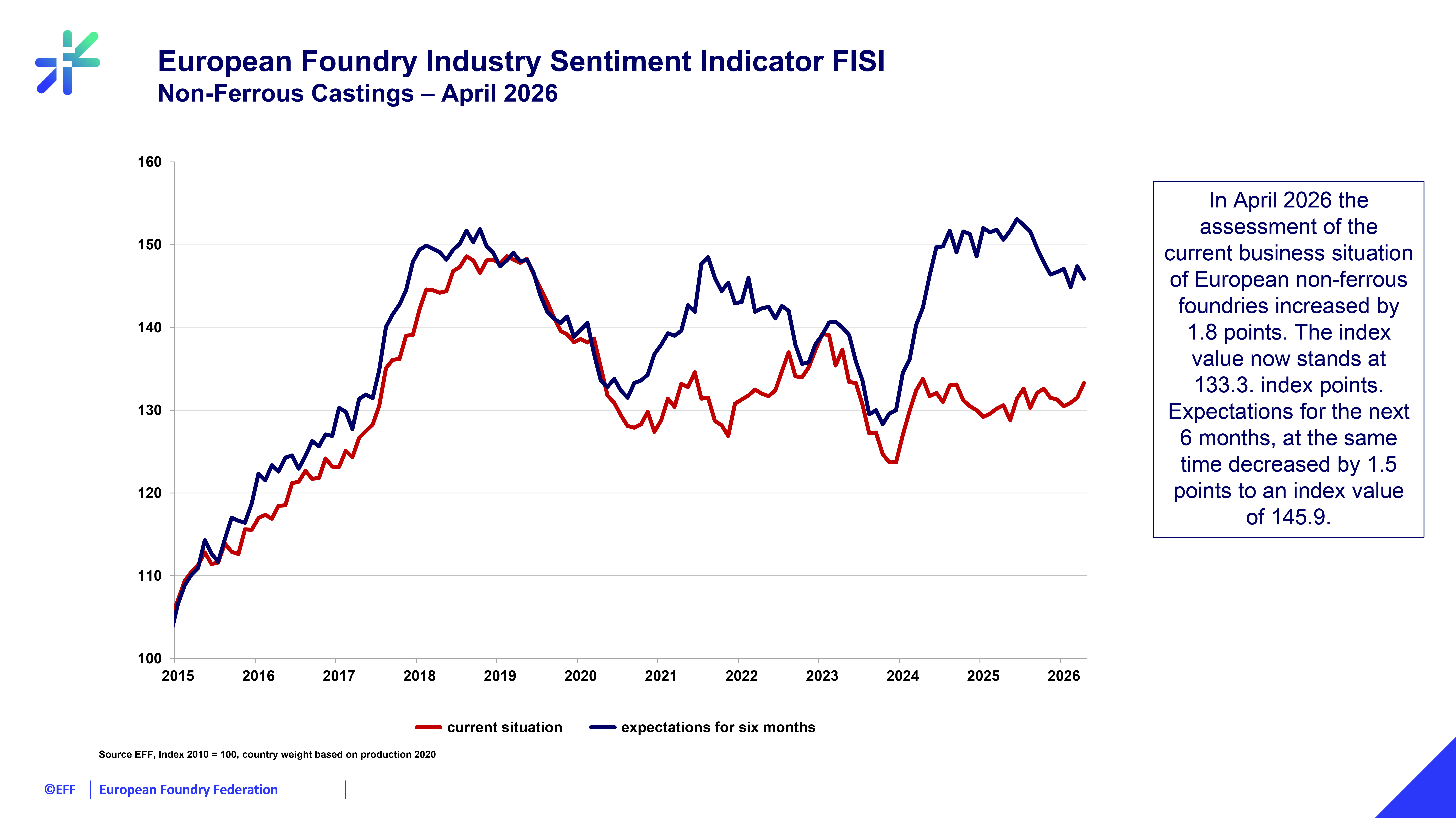
Les fonderies de métaux non-ferreux continuent de surpasser les autres secteurs de l'industrie européenne de la fonderie. En avril 2026, l'évaluation de la situation économique actuelle a progressé de 1,8 point pour atteindre 133,3 points d'indice. Dans le même temps, les prévisions pour les six prochains mois ont reculé de 1,5 point pour s'établir à 145,9 points, ce qui indique que, bien que l'activité du marché reste relativement forte, les entreprises se montrent plus prudentes quant à la pérennité de la croissance de la demande dans les mois à venir. Le segment des métaux non ferreux continue de bénéficier de la demande liée aux composants légers, à l'électrification, aux systèmes d'énergie renouvelable et aux applications de fabrication de pointe.

L'industrie européenne reste sous pression

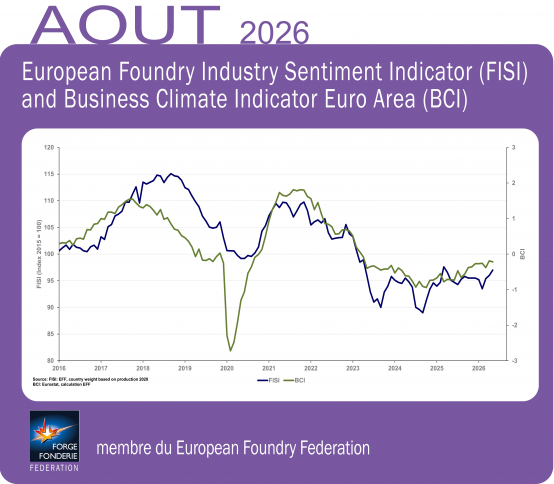
L’indice BCI (*) publié par la Commission européenne reste au même niveau qu’en mars 2026 (-0,27), reflétant la fragilité persistante de la confiance industrielle globale malgré certaines tendances à la stabilisation.

Dans le même temps, l'indice des directeurs d'achat (PMI Purchasing Managers’ Index**) de l'industrie manufacturière de la zone euro atteint 52,9, en légère hausse par rapport à mars.


Source : Traduction du communiqué EFF (https://eff-eu.org/european-foundry-industry-sentiment-78/).

(*) Indice BCI : Business Climate Indicator. Indice de l’évolution du secteur manufacturier en zone euro publié par la Commission européenne à partir d’enquêtes sectorielles (tendances de la production ; carnets de commandes ; carnets de commandes à l'exportation ; stocks ; attentes en matière de production). Valeur égale à 0 : Situation neutre, ni optimisme ni pessimisme marqué.

(**) L'indice des directeurs d'achat (PMI) dans la zone euro est un indicateur de la santé économique du secteur manufacturier. Il est basé sur des indicateurs tels que les nouvelles commandes, les niveaux de stocks, la production, les livraisons des fournisseurs et l'environnement de l'emploi.

News
June 1 2026

European Foundry Industry faces fragile recovery as April 2026 FISI signals persistent uncertainty

The European Foundry Industry Sentiment Index (FISI), published monthly by European
Foundry Federation (EFF), continues to operate in a challenging economic environment
marked by uneven demand, weak industrial momentum, and growing uncertainty about future
market conditions. According to the latest data the sector shows signs of stabilization in some
segments, while confidence regarding the next six months remains fragile.
The overall FISI indicator for April 2026 remained below the long-term benchmark, confirming
that Europe’s foundry sector is still struggling to regain sustained growth momentum despite
isolated improvements in several casting segments.
European Foundry Federation, representing national foundry associations across Europe,
notes that foundries continue to face significant pressures from high energy costs, geopolitical
instability, weak industrial output in key European markets, and ongoing uncertainty in
automotive and manufacturing supply chains.
Ferrous Castings: Stable current conditions but weaker outlook
In the ferrous castings segment, the assessment of the current business situation remained
unchanged in April 2026 at 98.7 index points. However, expectations for the next six months
declined further to 85.3 points, highlighting increasing caution among iron foundries across
Europe. The data suggests that while operational activity has stabilized in the short term,
companies remain concerned about future orders, investment activity, and broader industrial
demand across the European manufacturing sector.
Steel Foundries Show Slight Improvement
The steel castings sector recorded a modest improvement in current business conditions. The
current situation index increased by 0.8 points to 74.7 index points in April 2026. Expectations
for the next six months remained stable at 98.1 points. Despite the slight improvement, the
steel casting segment continues to operate well below historical averages, reflecting subdued
demand from heavy industry, machinery, and infrastructure-related sectors.
Non-Ferrous Foundries remain the strongest segment
Non-ferrous foundries continue to outperform other parts of the European foundry industry. In
April 2026, the assessment of the current business situation increased by 1.8 points to 133.3
index points. At the same time, expectations for the next six months declined by 1.5 points to
145.9 points, indicating that although market activity remains relatively strong, companies are
becoming more cautious regarding the sustainability of demand growth in the coming months.
The non-ferrous segment continues to benefit from demand linked to lightweight components,
electrification, renewable energy systems, and advanced manufacturing applications.

The broader Business Climate Indicator (BCI) for the euro area remains in negative territory,
reflecting continuing weakness in European manufacturing activity. At the same time, the
Eurozone Manufacturing PMI reached 52.2, signaling a slight expansion in manufacturing
activity. The latest FISI results underline the close relationship between the foundry sector and
the wider industrial economy in Europe.
European foundries remain strategically important suppliers for industries including
automotive, machinery, energy, railways, aerospace, defence, and infrastructure. However,
the sector continues to call for stronger European industrial policies supporting
competitiveness, investment, energy affordability, and industrial resilience.
EFF emphasises that maintaining a competitive European foundry industry is essential for
safeguarding industrial sovereignty and securing resilient European supply chains during a
period of global economic transformation.
________________________________________________________
The FISI – European Foundry Industry Sentiment Indicator – is the earliest available composite indicator
providing information on the European foundry industry performance. It is published by EFF every month and is
based on survey responses of the European foundry industry. The EFF members are asked to give their
assessment of the current business situation in the foundry sector and their expectations for the next six months.
The BCI – Business Climate Indicator – is an indicator published by the European Commission. The BCI
evaluates development conditions of the manufacturing sector in the euro area every month and uses five balances
of opinion from industry survey: production trends, order books, export order books, stocks and production
expectations.
Purchasing Managers' Index (PMI) - in the Euro area is an indicator of the economic health of the manufacturing
sector. It is based on such indicators as: new orders, inventory levels, production, supplier deliveries and the
employment environment.
Please find the chart enclosed or combined with additional information at eff-eu.org/.
Background information on EFF:
EFF is the umbrella organisation of the national European foundry associations. The organisation, founded in 1953,
has 22 European member states and works to promote the economical, technical, legal and social interests of the
EFF • European Foundry Federation

European foundry industry. At the same time, EFF implements activities which aim at developing national foundry
industries and co-ordinating their shared international interests. The General Secretariat is situated in Düsseldorf
since 1997.
EFF represents 4 400 European foundries. Nearly 260 000 employees are generating a turnover of 39 billion Euro.
European foundries are recruiting 20 000 workers and engineers per year. The main customer industries are e.g.
the automotive, the general engineering and the building industries as well as the electrical engineering industry.
No industrial sector exists without using casted components.
Further information at eff-eu.org/ and LinkedIn EFF.
___________________________________________________________________
EFF Contact:
Witold Dobosz
EFF – European Foundry Federation
mail: info@eff-eu.org
________________________________________

Read more
 
All news >
Directory
Forge Fonderie
Magazine
Indicators
Press Room
Join us
Contact

Fédération Forge Fonderie
Head office
45 rue Louis Blanc F-92400 Courbevoie
Write us
45 rue Louis Blanc CS 30080 92038 La Défense Cedex

Tel. +33 (0)1 43 34 76 30
Fax. +33 (0)1 43 34 76 31


Access map

The Fédération Forge Fonderie is the French professional organization of metal shaping industries through forging, casting, metal additive manufacturing and related machining.

© 2016 Fédération Forge Fonderie - Credits & legal notice