Back To Top
Plateforme adhérents
ENG
News
Accueil > News > Les perspectives du nucléaire pour les industries de la forge et de la fonderie : un collectif fortement mobilisé
Les perspectives du nucléaire pour les industries de la forge et de la fonderie : un collectif fortement mobilisé
25 September 2024
Partager | Imprimer

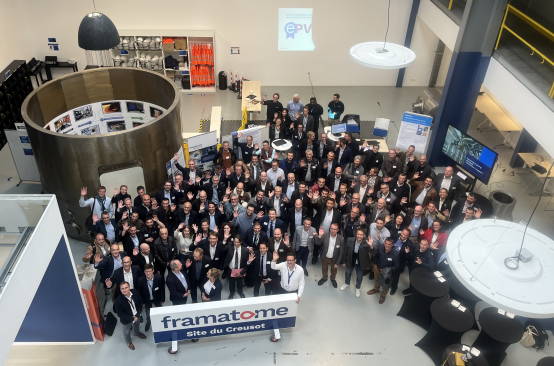
Succès confirmé pour la seconde édition du rendez-vous annuel de la profession consacré aux marchés du nucléaire : une centaine de participants étaient réunis sur le Campus Framatome du Creusot le 25 septembre dernier, en présence de son PDG Bernard Fontana.


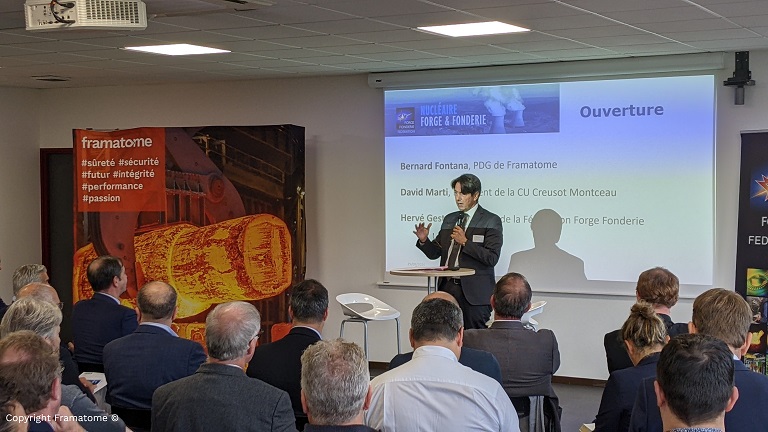
Ouverture de la journée par Bernard Fontana, PDG de Framatome


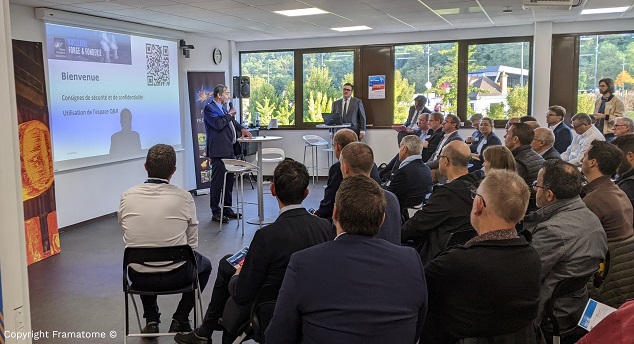
L’événement, organisé par la Fédération Forge Fonderie en collaboration avec le Groupement des industriels français du nucléaire (Gifen) et le pôle de compétitivité Nuclear Valley, a pour but de réunir les forgerons et les fondeurs en leur présentant une vue d’ensemble et dynamique de la filière nucléaire et offrant ainsi une plateforme d’échange avec toutes les parties prenantes : les exploitants et maîtres d’ouvrage, les équipementiers, les services de l’Etat et le CETIM.
 

Hervé Gestas, Président de la Fédération Forge Fonderie

Un site emblématique de la souveraineté industrielle française


Après une première édition réussie le 27 septembre 2023 à Saint-Dizier où les 80 participants ont visité le site des Aciéries Hachette et Driout, les participants ont été accueillis cette année sur le site du Creusot. Depuis les premières frappes du marteau-pilon à vapeur de 500 tonnes installé en 1876, cet établissement a été de tout temps à la convergence d’enjeux stratégiques des XIXème et XXème siècles, quand l’empire sidérurgique de la famille Schneider répondait aux besoins de la Défense nationale ou à la construction des grandes infrastructures de notre pays.


Depuis 1964 et la fabrication de la première cuve de réacteur, le site est spécialisé dans la fabrication de grandes pièces forgées et moulées en acier carbone ou inoxydable, nécessaires pour la fabrication des composants primaires d’une centrale nucléaire. 3500 pièces ont été produit depuis cette date : couvercles et viroles de cœur de cuve de réacteur, viroles et dôme elliptique de générateurs, éléments de tuyauterie primaire etc… Le site est également un contributeur majeur du secteur de la Défense nationale : c’est le seul fabricant français à même de réaliser les ébauches pour les chaudières embarquées de la propulsion nucléaire.
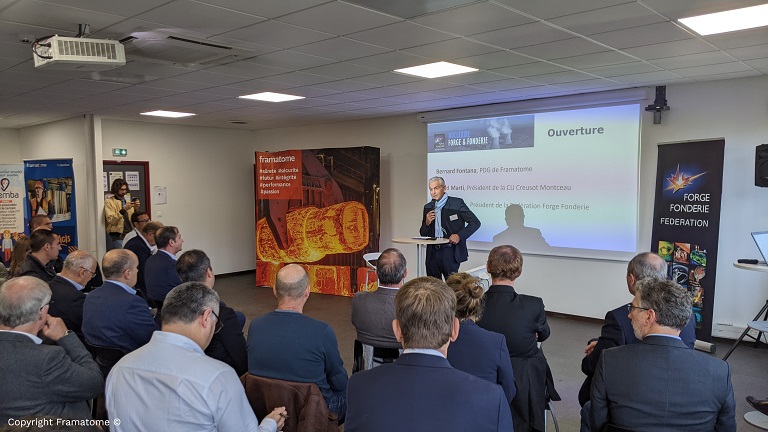
 

David Marti, Maire du Creusot et Président de la Communauté Urbaine Le Creusot Montceau
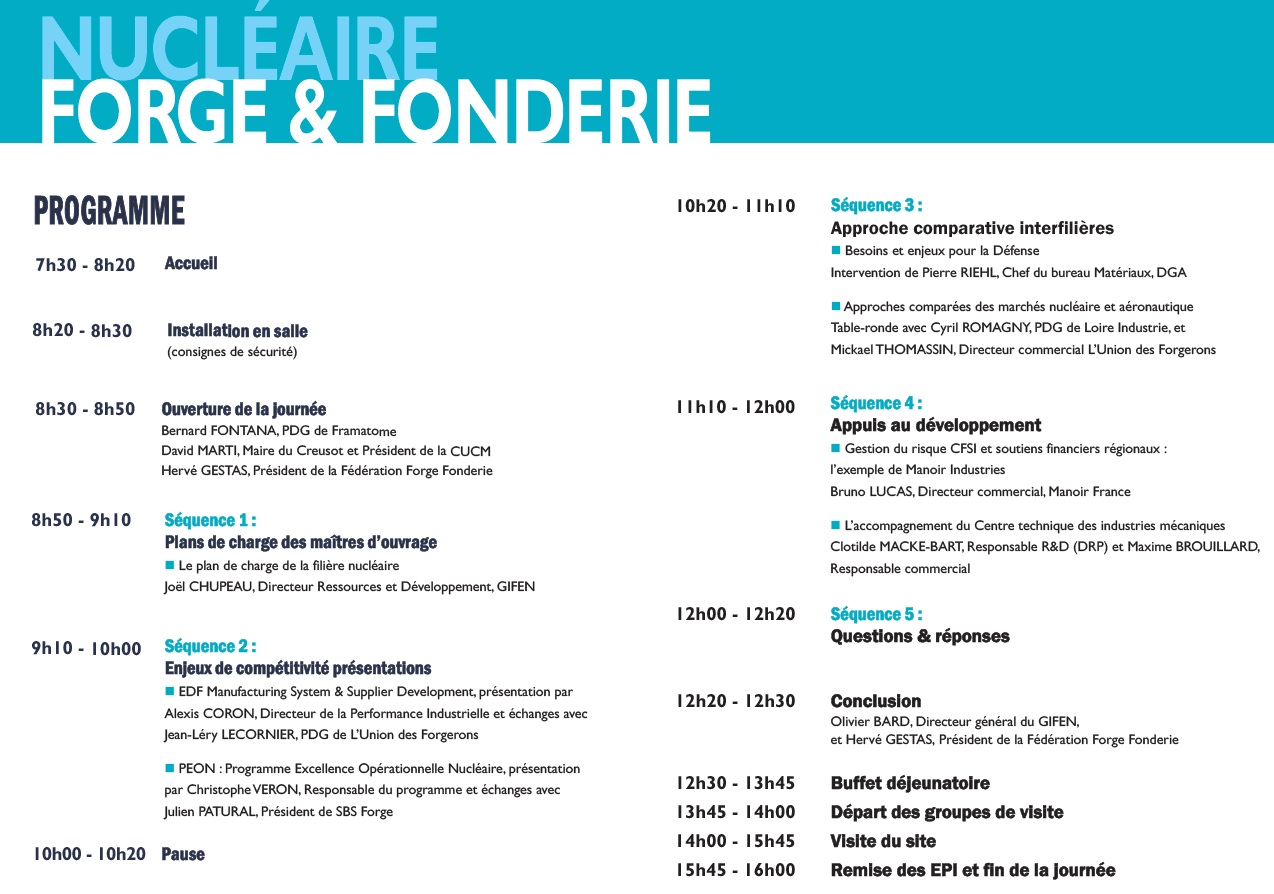
 

Le programme de la matinée


EDF Manufacturing System & Supplier Development, présentation par Alexis CORON Directeur de la Performance Industrielle et échanges avec Jean-Léry LECORNIER, PDG de L’Union des Forgerons
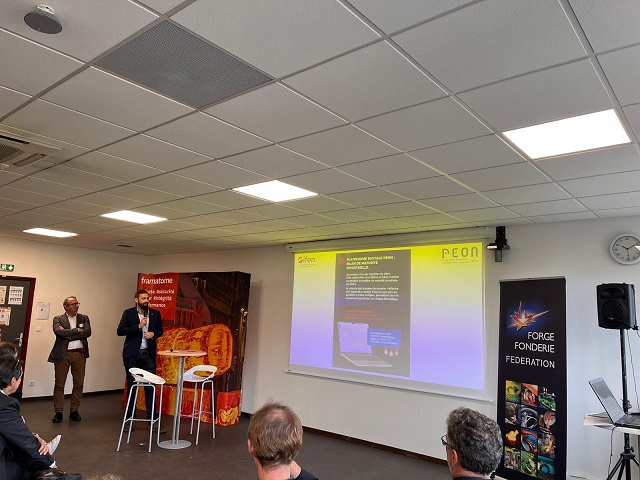
PEON : Programme Excellence Opérationnelle Nucléaire, présentation par Christophe VERON Responsable du programme et échanges avec Julien PATURAL SBS Forge.
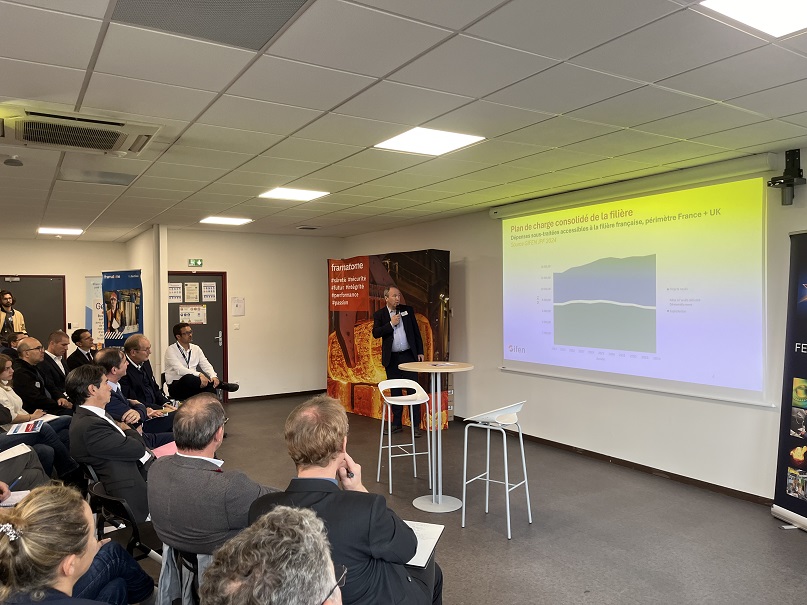
 

Joël Chupeau, Directeur Ressources et Développement du Gifen, présente le plan de charge actualisé de la filière nucléaire.
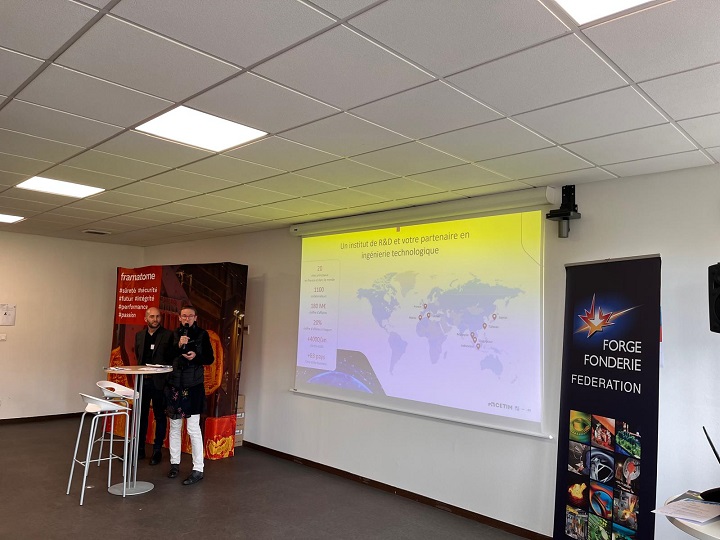
 

Clotilde Macke-Bart, responsable R&D et chargée d'instance Fonderie, et Maxime Brouilllard, responsable commercial, présentent les solutions et des exemples de projets portés par le CETIM pour répondre aux enjeux de la filière nucléaire française.
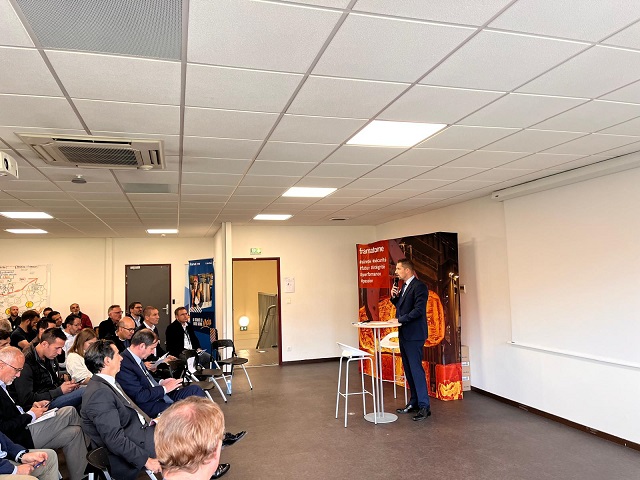
 

Pierre Riehl, Chef de bureau Matériaux, Direction Générale de l'Armement.


L'outil industriel de l'usine du Creusot

A l'heure du déjeuner, rendez-vous au rez-de-chaussée de l'ancien atelier de maintenance désormais le show room - et son imposante virole - du Campus Framatome. L'entreprise a en effet mis en place une stratégie de développement des compétences et de recrutements, avec l'objectif d'accorder au mieux les compétences et les savoir-faire des équipes aux enjeux contemporains.
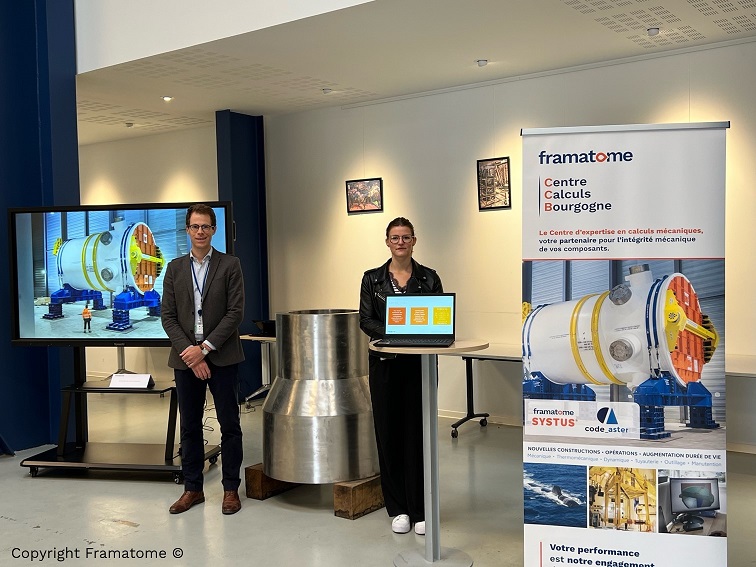
 

 Centre Calculs Bourgogne (CCB) : le centre d’expertise et de formation dédié au Calcul Mécanique
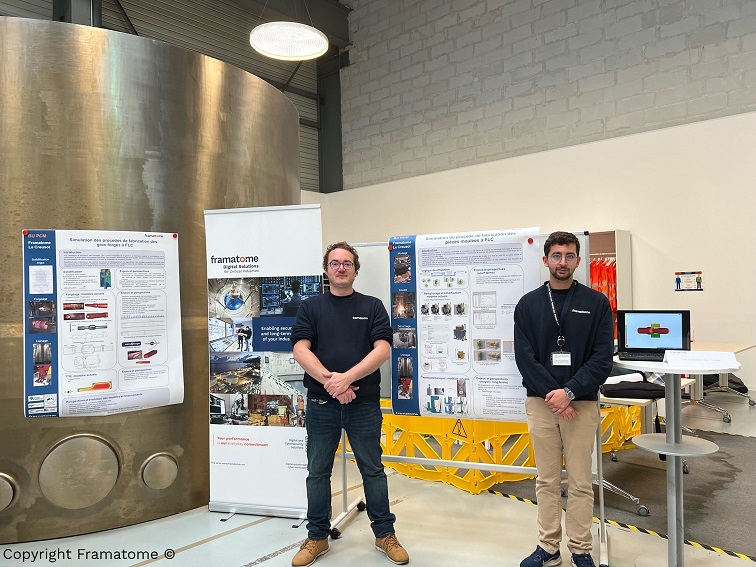
 

Framatome Digital Solutions : solutions digitales pour sécuriser et simplifier la conception et l’exploitation des systèmes les plus critiques.
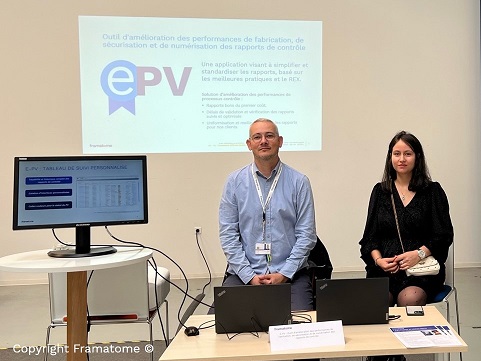
 

E-PV : outil de digitalisation des rapports de contrôle


L’après-midi, deux heures étaient consacrées à une visite guidée d’une partie du site. Tout d’abord la « forge » à proprement parler, dit atelier HO, aux dimensions de cathédrale industrielle, où sont installées notamment les presses hydrauliques de 9000 et 11300 tonnes, desservies par un manipulateur de 200 tonnes, et les 14 fours pouvant accueillir des pièces jusqu’à 600 tonnes pour les monter jusqu’à une température de 1300°C en quelques heures. Puis l’un des deux ateliers d’usinage (atelier AU), abritant des tours verticaux et horizontaux dont un tour Wagner d’après-guerre toujours en service ! Le site comprend également une fonderie, un atelier de découpe d’éprouvettes et un laboratoire d’essais mécaniques et d’analyses chimiques.

News
September 3 2026

European Foundry Industry Sentiment in July 2026

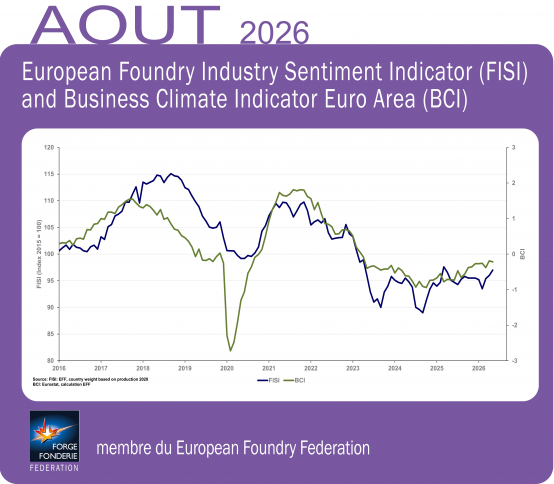
European Foundry Industry Sentiment improves in July 2026, but recovery remains uneven. FISI rises to 96.0 as Eurozone manufacturing continues to expand.
The European foundry industry recorded a further improvement in business sentiment in July 2026. The European Foundry Industry Sentiment Indicator (FISI), published monthly by EFF – European Foundry Federation. increased to 96.0 points, confirming the gradual stabilisation observed in recent months. Nevertheless, the indicator remains below the benchmark level of 100, showing that the recovery of the European foundry sector is still fragile and highly uneven across individual casting segments.


The development of FISI should also be viewed against the background of a slowly improving European manufacturing environment. The Eurozone Manufacturing PMI reached 52.0 points in July, remaining above the critical threshold of 50 and therefore signalling an expansion of manufacturing activity.
At the same time, the Business Climate Indicator (BCI) stood at -0.19, remaining in negative territory despite the improvement in manufacturing activity. The combination of a PMI above 50 and a still-negative BCI illustrates the mixed economic environment facing European industry: production activity is recovering, but companies remain cautious about demand, investment and future business conditions.
Iron foundries improve, but expectations weaken
The situation in European iron foundries improved noticeably in July. The assessment of the current business situation increased by 1.4 points to 100.0 index points. This is an encouraging signal, bringing the assessment of current conditions back to the benchmark level. However, expectations for the next six months moved in the opposite direction, decreasing by 1.1 points to 85.3.
The divergence between improving current conditions and weakening expectations indicates that iron foundries remain cautious about the sustainability of the recovery. Demand from major customer industries remains uneven, and companies continue to operate in an environment characterized by uncertainty regarding future orders, industrial investment and production volumes.
Steel foundries remain the weakest segment
The steel casting sector continues to face the most difficult market conditions among the major European foundry segments. In July, the assessment of the current business situation of European steel foundries increased only marginally, by 0.1 point to 74.3 index points. At the same time, expectations for the next six months decreased by 1.3 points to 97.6 points.
The very low assessment of the current situation confirms that steel foundries continue to struggle with weak demand and insufficient capacity utilization. Although expectations remain significantly above the assessment of present conditions, their decline in July suggests that companies are becoming somewhat more cautious about the pace of a future recovery.

Non-ferrous foundries remain the strongest part of the industry
The situation is considerably more positive in the European non-ferrous foundry sector. In July 2026, the assessment of the current business situation increased by 1.3 points to 133.2 index points. At the same time, expectations for the next six months improved strongly, rising by 2.9 points to 149.0.
Non-ferrous foundries therefore remain by far the strongest segment of the European foundry industry. Both current conditions and expectations are substantially above the benchmark level.
The segment continues to benefit from structural demand connected with lightweight components, electrification, energy technologies and advanced industrial applications. The July results show that non-ferrous foundries continue to demonstrate considerably greater resilience than the ferrous casting sectors.


European manufacturing recovery offers cautious optimism
The Eurozone Manufacturing PMI of 52.0 in July provides an important positive signal for foundries. A PMI above 50 indicates expanding manufacturing activity and suggests that the broader industrial environment is gradually becoming more supportive.
This follows the stabilization already observed in the European foundry sector in June, when EFF reported the first meaningful improvement in business sentiment after several challenging months. However, the July figures show that the recovery has not yet translated into equally strong confidence across all foundry segments.
European foundries remain exposed to weak and uneven demand from key customer industries, high energy and production costs, geopolitical uncertainty and increasing global competition. EFF has also highlighted the importance of creating a level playing field for European foundries in the context of the Carbon Border Adjustment Mechanism (CBAM). The Federation has warned that the current framework risks increasing the cost of imported raw materials while leaving many imported finished foundry products outside the mechanism’s scope. This imbalance represents a significant competitiveness challenge for an energy-intensive European industry already facing strong competition from third-country producers.

Outlook: stabilization, but no broad-based recovery yet
The July 2026 FISI results provide grounds for cautious optimism. The rise of the overall indicator to 96.0, combined with a Manufacturing PMI of 52.0, suggests that the European industrial economy is moving in a more positive direction.
However, the BCI of -0.19 and the significant differences between individual foundry segments demonstrate that a broad-based recovery has not yet been achieved.
The contrast is particularly striking: non-ferrous foundries report very strong current conditions and expectations, while steel foundries continue to operate at historically weak levels. Iron foundries are experiencing an improvement in their current situation, but their expectations for the coming six months remain subdued.
For the European foundry industry, the coming months will therefore be decisive. A sustainable recovery will depend on stronger order intake from key customer sectors, continued improvement in European manufacturing, competitive energy prices and an EU industrial and trade policy capable of protecting the competitiveness of European production.
European foundries are strategically important suppliers to the automotive, machinery, energy, railway, aerospace, defense, construction and infrastructure sectors. Maintaining a competitive European foundry industry is therefore essential not only for individual companies, but also for resilient European industrial supply chains and Europe’s long-term industrial sovereignty.

The FISI – European Foundry Industry Sentiment Indicator – is the earliest available composite indicator providing information on the European foundry industry performance. It is published by EFF every month and is based on survey responses of the European foundry industry. The EFF members are asked to give their assessment of the current business situation in the foundry sector and their expectations for the next six months.
The BCI – Business Climate Indicator – is an indicator published by the European Commission. The BCI evaluates development conditions of the manufacturing sector in the euro area every month and uses five balances of opinion from industry survey: production trends, order books, export order books, stocks and production expectations.
Purchasing Managers' Index (PMI) - in the Euro area is an indicator of the economic health of the manufacturing sector. It is based on such indicators as: new orders, inventory levels, production, supplier deliveries and the employment environment.
Please find the chart enclosed or combined with additional information at eff-eu.org/.
Background information on EFF:
EFF is the umbrella organisation of the national European foundry associations. The organisation, founded in 1953, has 22 European member states and works to promote the economical, technical, legal and social interests of the European foundry industry. At the same time, EFF implements activities which aim at developing national foundry industries and co-ordinating their shared international interests. The General Secretariat is situated in Düsseldorf since 1997.
EFF represents 4 400 European foundries. Nearly 260 000 employees are generating a turnover of 39 billion Euro. European foundries are recruiting 20 000 workers and engineers per year. The main customer industries are e.g. the automotive, the general engineering and the building industries as well as the electrical engineering industry. No industrial sector exists without using casted components.
Further information at eff-eu.org
___________________________________________________________________
EFF Contact:
Witold Dobosz
EFF – European Foundry Federation
mail: info@eff-eu.org
________________________________________

Read more
 
All news >
Directory
Forge Fonderie
Magazine
Indicators
Press Room
Join us
Contact

Fédération Forge Fonderie
Head office
45 rue Louis Blanc F-92400 Courbevoie
Write us
45 rue Louis Blanc CS 30080 92038 La Défense Cedex

Tel. +33 (0)1 43 34 76 30
Fax. +33 (0)1 43 34 76 31


Access map

The Fédération Forge Fonderie is the French professional organization of metal shaping industries through forging, casting, metal additive manufacturing and related machining.

© 2016 Fédération Forge Fonderie - Credits & legal notice